
Custom Jewelry Wholesale: Minimums, Lead Times and Materials
Three numbers decide whether a wholesale jewelry program is workable: the floor quantity per design, the sampling window and the production block. The MOQ by base material is 50 in the silver line, 100+ pcs in stainless steel and 100 pieces in the eco-brass line, per design quoted per design. Lead times are the part buyers underestimate, so start there.
Key takeaways
- Order floors are 100+ pcs in the stainless line, 50 pcs in sterling silver and 100 units in the eco-brass line, per design, applied design by design.
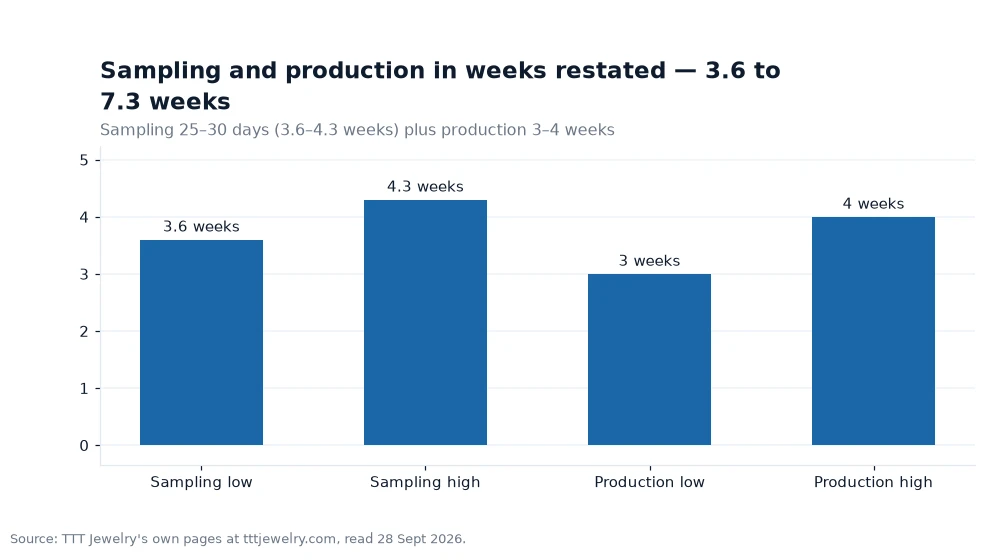
- Sampling runs 25–30 days and converts to 3.6–4.3 weeks; bulk production adds a further 3–4 weeks.
- CAD drawings and renderings come back in under 48 hours, which is the least expensive stage to change a design.
- The finish list: multi-layer gold (14K, 18K, 24K), rhodium, then silver and brass sealed with anti-tarnish e-coating and PVD on stainless steel.
Why the floor quantity differs by material
A minimum order quantity is a manufacturing fact rather than a policy. stainless steel, artisan brass with recycled content and 925 silver is machined or stamped and then vacuum plated, which pushes the floor to 100+.
That ladder has a practical consequence for a buyer building a range. If you want breadth, silver gives you the most designs per unit of cash tied up in stock. If you want a low unit cost and a fashion cycle, brass at 100 pieces per design is the usual compromise.
The timeline, restated in weeks
Factories quote in days and buyers plan in weeks. A 25-day sampling window is 25 ÷ 7 = 3.6 weeks, and 30 days is 30 ÷ 7 = 4.3 weeks. Bulk production is already quoted in weeks at 3–4. So a complete first order runs from roughly 6.6 weeks to 8.3 weeks of factory time, and your own approval gaps sit outside that arithmetic.
Where the schedule usually slips is not the bench, it is the handover points. A sample that arrives and is not reviewed for five days has cost you five days. The published response standard of 24 hours and a 1-on-1 project manager exist to compress the other side of that exchange, not to shorten the bench work.
Anyone setting up a custom jewelry wholesale range for the first time should build the calendar backwards from the launch date instead of forwards from the enquiry. Pick the week the pieces must sit on a shelf, subtract the shipping and customs buffer, then subtract 3–4 weeks of production, then subtract 25–30 days of sampling, and see whether anything is left for the drawing stage. If the answer is negative, the design has to be simplified or the launch moved, and both of those conversations are much shorter when they happen before tooling rather than after.
Materials and the finishes that follow them
Base metal and finish are linked, and changing one usually changes the other. The published matrix lists three base materials — 925 sterling silver, brass and stainless steel — and a plating menu of multi-layer electroplating in 14K, 18K and 24K gold or rhodium. Silver and brass additionally take a protective anti-tarnish e-coating; stainless steel is finished by PVD vacuum plating instead.
Hallmarks follow the same logic and are applied by high-precision laser engraving: 316L for stainless steel, 18KGP for gold-plated pieces and S925 on silver on gold-plated pieces. If your retail listing quotes a material, the hallmark on the piece should say the same thing. Chains and findings, stones and freshwater pearl accents, and the packaging set are the remaining specification fields.
What the minimum actually protects
A floor is also a tooling guarantee. Moulds, CAD files and the finished collection stay exclusive to the buyer under a published 100% NDA, so a 50-piece run does not turn up in another brand's line six months later. For a wholesale program selling into several shops, that exclusivity is usually worth more than a lower unit cost.
| Parameter | Published figure | Planning effect |
|---|---|---|
| 925 sterling silver floor | 50 pcs per design | Widest range for a fixed inventory budget |
| Artisan eco-brass floor | 100 pcs per design | Plating tank run per batch |
| Stainless steel floor | 100+ pcs per design | Machining plus PVD finishing |
| Master sampling window | 25–30 days | Sample rounds before bulk release |
| Mass production block | 3–4 weeks | Repeat-order lead time |
Worked example: turning the published windows into a calendar
Assume an approved CAD file on day zero. Sampling takes 25–30 days, so the fastest sample lands at day 25 and the slowest at day 30. Production then adds 21–28 days. The earliest possible shipping date is therefore 25 + 21 = 46 days, and the latest is 30 + 28 = 58 days, before the 48-hour CAD stage is counted.
Add the CAD block and the range becomes 48 hours plus 46 to 58 days, which is 6.9 to 8.6 weeks — the rough "seven to nine weeks" figure buyers usually plan with. If a wholesale order is going to be late, it is almost always because one of those three blocks was re-run, and a re-run sample puts you back at the start of the 25–30 day window.
Compliance questions a wholesale buyer should ask
Three published statements matter when your shops ask for paperwork. A BSCI social audit, REACH limits on lead, cadmium and nickel and the ISO 9001:2015 standard, cadmium and nickel, and the plating is stated as compliant with REACH and California Proposition 65 limits.
Ask for the restriction list behind the materials statement rather than the badge alone, and match it against the markets you ship to. For a European or North American wholesale program, the REACH list and the nickel restriction on plated skin-contact pieces are the two that come up in customer complaints.
Frequently asked questions
Is there a single MOQ for every material?
No. The minimums are 50 pcs in artisan eco-brass, 925 silver and stainless work, by design, so a two-design range doubles those figures.
Why does sampling take longer than production?
Sampling includes wax printing, mould casting, stone setting, polishing and electroplating on a single piece, and each operation can be adjusted and repeated; production runs the approved route once.
Can I mix materials inside one collection?
Yes, and it is common: silver for the hero piece, brass for plated fashion lines and stainless steel for pieces that need to survive water and daily wear, each at its own published floor.
Checking a supplier against these numbers
Put the three published windows next to your launch calendar and see whether they fit before you discuss anything else. A maker that will not state a sampling window is a maker you cannot schedule against. If your program spans several materials, the OEM/ODM capability breakdown explains how the design files and tooling are handled, and the artisan eco-brass line shows how a plated base metal is finished for retail.
What is cited here — the six customisation points as well as the five-step service flow as well as the five packaging components — is documented at the client's own website at the tttjewelry.com address, in a visit dated 28 Sept 2026. CAD drawings return in under 48 hours. No figure above is estimated. The day-and-week bookkeeping is my own working, while the source figures stay the client's [1]